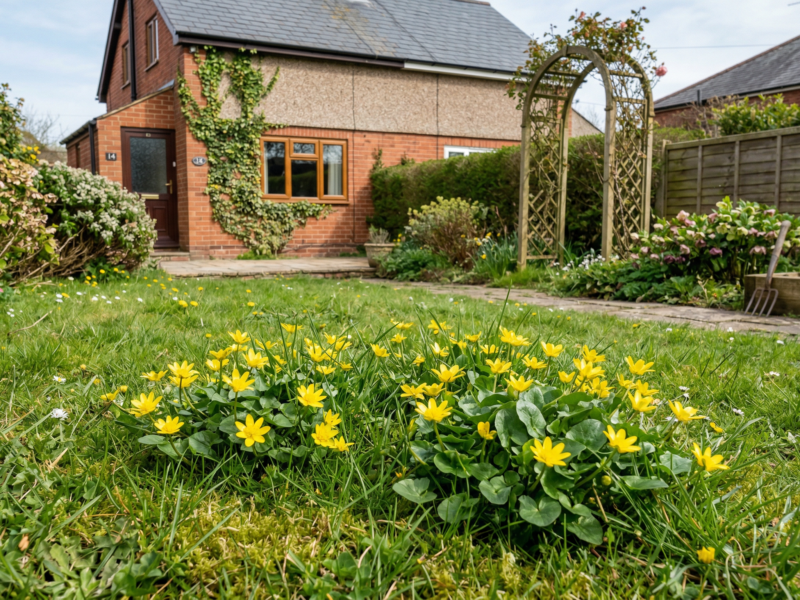

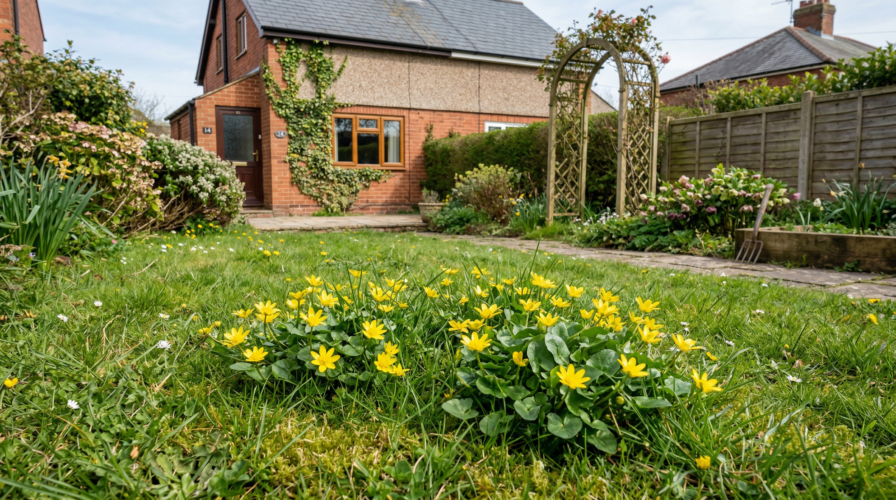
As the days begin to lengthen and temperatures creep upward, you may notice a small but striking plant appearing across your lawn almost overnight. Known as Celandine (Ranunculus ficaria, also sometimes called Lesser Celandine), it is one of the earliest flowering plants to make an appearance each year, and its arrival can catch many homeowners off guard.
With its glossy, deep-green leaves and vivid yellow buttercup-like flowers, Celandine is easy to spot against the paler, still-recovering grass of late winter and early spring. If you have noticed it spreading across your lawn, you are far from alone, it is a remarkably common visitor to gardens and lawns across the country.
Why Celandine behaves differently to other weeds
Unlike many of the broadleaf weeds that trouble lawns later in the season, Celandine grows from small, fleshy, bulb-like tubers beneath the soil’s surface. These underground structures allow it to store energy over winter and emerge rapidly as soon as conditions warm. This is why it appears so suddenly and with such vigour, it has been quietly waiting just below the surface since the previous year.
This growth habit also explains why Celandine does not respond well to standard lawn weed treatments. Most selective herbicides target actively growing, leafy weeds and are absorbed through the foliage. Because Celandine draws much of its strength from those underground tubers, surface treatments are far less effective, and in most cases, will not give you the results you are hoping for.
Its life cycle: short, sharp, and self-limiting
Here is the reassuring part: Celandine is what botanists call an ephemeral plant. It lives fast and disappears quickly. Its entire above-ground life takes place over just a matter of weeks in early spring, and it typically begins to yellow, collapse, and fade naturally from around mid-April onward.
By the time your grass really gets growing in mid to late spring, the Celandine will have all but disappeared. It rarely causes any lasting damage to a healthy lawn, and in most cases you will not even notice it has been there once the season is underway.
Our advice: Do not apply chemical treatments to Celandine on your lawn. They are generally ineffective against this particular weed, and given how briefly it sticks around, they are simply not necessary.
What if it is spreading into flowerbeds or borders?
While Celandine is largely harmless on the lawn itself, it can become more of a nuisance if it spreads into flowerbeds or borders. The tubers can establish themselves readily in loose, cultivated soil, and if left unchecked, dense patches can develop over time that are trickier to clear.
If you notice it encroaching into planted areas, the best approach is to remove it by hand as soon as it appears, before it has had the chance to spread further or deposit new tubers. Use a hand fork to gently loosen the soil and ease out as much of the root system as possible. Try to avoid breaking the tubers up, as small fragments left in the ground can regenerate. Bag up any material you remove rather than composting it, to reduce the risk of spreading it elsewhere.
Repeating this process across two or three seasons will significantly reduce the population over time, as you steadily deplete the energy stored in the tubers.
The best approach for your lawn
For the lawn itself, the best course of action is simply to continue with your regular maintenance routine. Keep mowing on a sensible schedule as growth allows, and if you have not already done so, spring is an excellent time to apply a quality lawn feed to help your grass thicken up and strengthen ahead of the summer months.
As temperatures rise and your grass grows more vigorously, it will naturally outcompete the Celandine, and the weed will retreat on its own. A dense, well-maintained lawn is one of the best long-term defences against most weeds, Celandine included.